A Weekend Nation investigation has exposed how regulatory authorities snored on the job as a coal-driven environmental disaster in Lilongwe unfolded right under their noses for months.
Our findings based on documents review and interviews show that Malawi Environmental Protection Agency (Mepa), Malawi Energy Regulatory Authority (Mera) and Lilongwe City Council (LCC) failed hundreds of workers and service providers around Kanengo in the capital by not acting on a transit facility hosted by Central East African Railways (Cear) and operated by Nacala Logistics that was emitting coal dusts that experts say are harmful to human beings.
Mepa and Mera confirmed that the facility, which started functioning in October 2024, operated without crucial environmental safeguards required by law and that it had no licence for coal supply activities.
By the time written complaints from neighbouring companies to Mepa finally woke up the agency from its slumber and triggered it to investigate the matter and eventually shut down the facility, the persistent pollution had disrupted daily operations of roughly 400 workers around the Kanengo area plus service providers such as vendors since August last year when people started complaining.
Beatrice Malunga, who runs a food stall just 200 metres away from the Cear site, expressed worry in an interview on April 10 2026 that the soot settling onto their food could affect her health and that of her customers.
Some of the workers we talked to said they had to wipe black grit off their computer keyboards every morning in their offices.
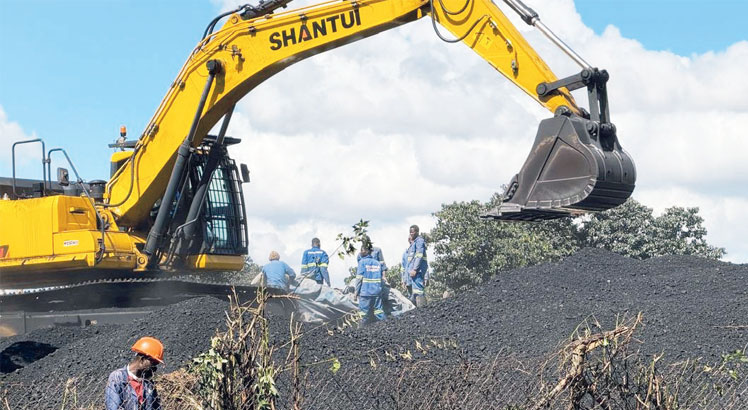
transit facility in Lilongwe. | Ntchindi Meki
An employee at Fumigation International—one of the companies that lodged a formal complaint to Mepa on April 14 2026—who requested anonymity out of fear of reprisals, summarised the frustration in a separate interview on April 15 this year: “We are paying [the price] for someone else’s poison.”
Coca-Cola Beverages Malawi, which established its national headquarters and expanded its manufacturing capacity at this Kanengo site as a subsidiary of Coca-Cola Beverages Africa, also formerly complained to both Nacala Logistics and Mepa regarding the coal dust pollution and demanded redress.
Kamuzu University of Health Sciences professor of public health Adamson Muula warned that inhaling coal dust daily for months puts individuals at high risk of restrictive lung diseases such black lung.
Black lung is the incurable condition also called coal workers’ pneumoconiosis in which the essential breathing organs become stiff and lose their capacity to expand, depriving the body of necessary oxygen.
Muula noted that other serious risks from coal dust include tuberculosis, chronic bronchitis and asthma.
“Coal dust also paralyses the lungs’ natural defence mechanisms,” Muula explained. Asked if the respiratory damage is permanent, he was unequivocal: “Yes, it is irreversible. Once the scarring happens, it cannot be undone.”
Muula added that there is no safe threshold for exposure.
“Just as with cigarette smoking, there is no safe level of exposure. While the body can filter out short-term, single-day contact, the workers at Kanengo have been trapped in this environment for at least eight months,” he explained.
According to the National Institutes of Health (NIH) in its 2024 Global Burden of Disease study on coal workers’ pneumoconiosis, chronic exposure to coal dust causes severe health hazards, including coal workers’ pneumoconiosis (black lung disease), persistent coughing, eye irritation and permanent lung scarring.
In its investigation report dated April 30 2026, Mepa found that Cear moved and stored coal at the Kanengo Industrial Site without an Environmental Impact Assessment (EIA), an Environmental and Social Impact Assessment (Esia) certificate or a valid coal supply licence.
According to Mepa, an EIA is the bedrock of environmental law in Malawi and must be secured before any project begins.
The Mepa inspection also unmasked several environmental violations, including uncontrolled dust dispersion, a lack of water suppression, employees working without protective gear, soil contamination from fuel leaks, unlicensed waste discharge points and structural damage to public roads caused by heavy trucks.
One of the most startling revelations of the entire saga lies within finding number 13: the missing coal supply licence.
Among its core findings, the environmental watchdog noted that “no coal transport or storage licences were submitted to the authority upon request.”
Furthermore, finding number 13 pointed out “non-compliance with the Energy Regulation Act (Cap. 73:02, Section 37)—operating without a valid coal supply licence.”
Mera not only corroborated Mepa’s findings, but revealed an even wider regulatory vacuum.
“Mepa’s observation is entirely correct,” said Mera spokesperson Fitina Khonje. “The company does not possess a coal supply licence. In fact, at this moment, no company in Malawi holds such a licence issued by Mera.”
Khonje admitted that the country’s energy and mining laws are fundamentally misaligned, calling for an urgent legislative review to synchronise the Energy Regulation Act and the Mining Act regarding how bulk coal is handled and regulated nationally.
Following the findings of the investigations, Mepa ordered Cear to halt all coal-related operations immediately, commission an environmental audit, apply for an Esia certificate, install proper dust suppression systems and compensate affected businesses.
Mepa spokesperson Aubren Chirwa confirmed the investigation’s findings, reiterating that Cear generated unmanaged dust and operated illegally without an Esia certificate.
He warned that if the firm disregards the Environmental Protection Order that Mepa director general Wilfred Kadewa issued on April 30, 2026 under Section 72 of the Environment Management Act (2017), Section 73 of the Act empowers Mepa to take stiffer legal sanctions, including criminal enforcement measures.
Chirwa said Section 4 of Environment Management Act gives every person the right to a clean and healthy environment.
“However, the duty to enhance and safeguard the environment imposed under subsection (1) includes the duty to inform the Authority or a relevant lead agency of all activities or phenomena that may affect the environment significantly and shall be exercisable by individual persons, public authorities, non-governmental organizations, or local environment and natural resources committees.
“Now, based on this understanding, the authority is not present everywhere despite that it has its scheduled/routine inspections it conducts. In this case, the authority encourages the public to continue informing it so that their rights to a cleaner environment should not be compromised.”
Chirwa also said the Authority acts swiftly after being tipped of such similar violations and believes that the violations it identified demonstrateit is a fully functional entity but still requiring support from the citizens and other agencies, NGOs, etc Currently.”
He said the Authority is still establishing itself considering that its operationalisation began towards the end of 2025 when some members joined organisation on a full-time basis.
The corporate and local response
In the wake of the order, Cear announced that it has suspended all coal handling at the yard.
On the missing Esia certificate, Cear spokesperson Wezzie Kalua argued that an assessment had previously been conducted for “trains on the Nkaya to Mchinji railway section” and for “general cargo handling activities”.
However, the company could not produce an Esia certificate specifically clearing coal transport and storage at the Kanengo depot, the exact core violation Mepa cited.
Regarding dust control, Cear said the coal it receives from the mine in Moatize, Mozambique is treated with a chemical polymer prior to transporting it to minimise emissions. Kalua admitted, however, that local conditions may have affected effectiveness.
“There could be a possibility that these measures may not have been fully sufficient under all operating conditions”
Cear also confirmed finding number five, admitting to a “small, localised area” where fuel had leaked into the soil at the dispenser, stating that corrective clean-up measures were underway.
On the matter of compensating victims, Kalua noted that Cear is reviewing the directives and will engage independent valuers “where required”.
On administrative fines, Cear stated that “any decisions regarding penalties or corrective actions will be taken in line with the company’s internal governance processes”.
It was not just the central government regulators that were caught napping on duty as capital city fathers were in their own dreamland while their residents breathed in toxic dusts.
Lilongwe City Council spokesperson Kate Chintu admitted that despite the months of people choking on black fog, the city’s environmental health officers had not noticed the issue.
“At the moment, the Lilongwe City Council has not received any formal complaints from the affected companies or workers regarding the alleged coal dust emissions,” Chintu claimed.
“However, the council has noted the urgent concerns raised through your journalistic inquiry.”
Chintu promised that the council would finally dispatch its environmental health officers to conduct an independent site inspection, noting that city by-laws strictly prohibit activities that create a public dust nuisance.
According to municipal codes, any company handling bulk materials is legally required to implement proper containment, cover stockpiles, and run active dust suppression systems.